Case file · The time-saver
Statbook
The problem: UK employment figures — statutory rates, limits, thresholds — are scattered, frequently updated, and painful to cite with confidence. Statbook is a single registry where every figure is permanently cited to its governing authority.
The honest outcome: It re-verifies every figure nightly and publishes a public corrections log. The numbers stay right while everyone sleeps.
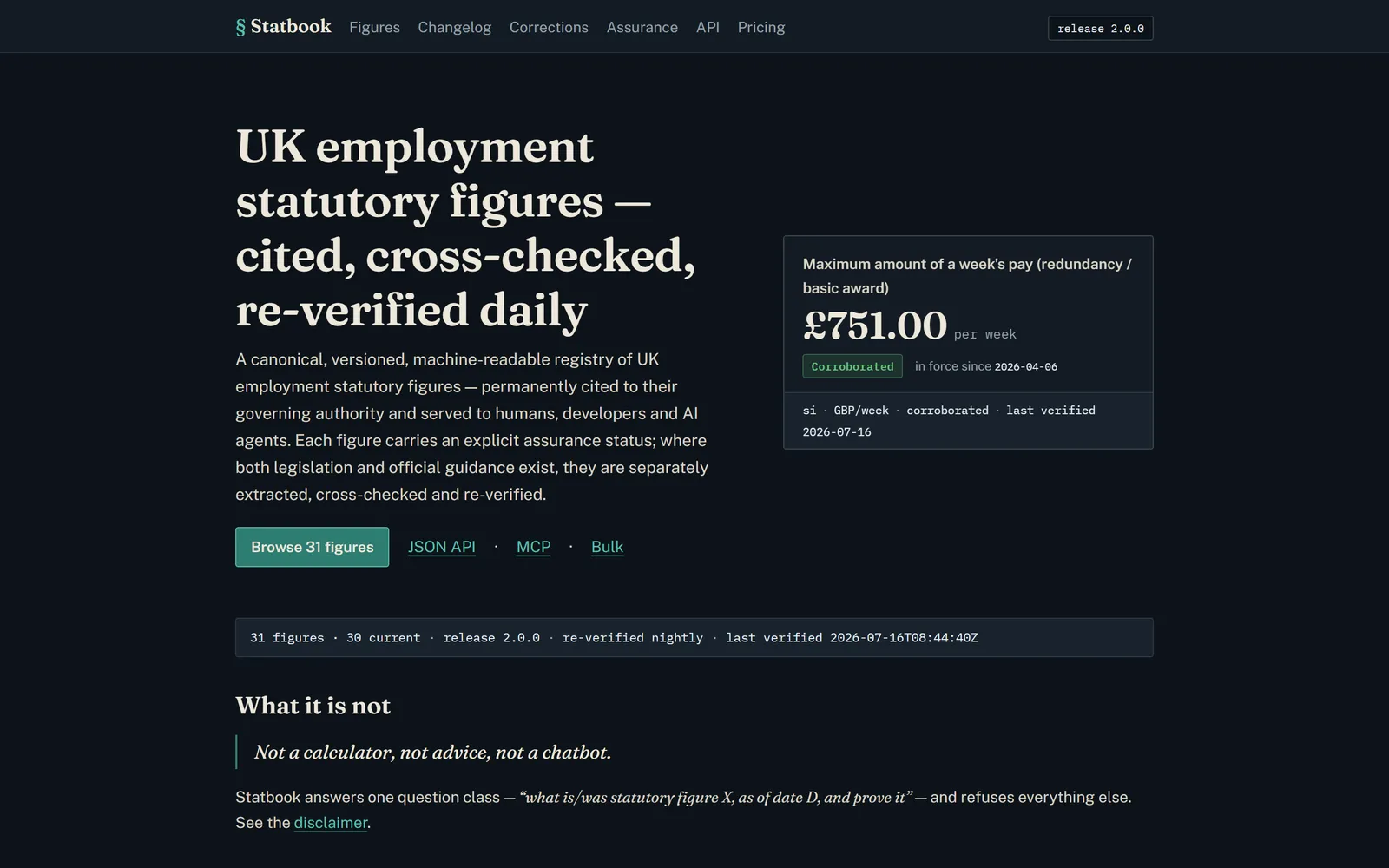
One question, answered properly
Not a calculator, not advice, not a chatbot. Statbook answers one kind of question: what is, or was, statutory figure X as of date D — and prove it. Narrowing it that far is why a small registry ended up with a verification model more thorough than products ten times its size.
What “prove it” means
Every figure carries a citation to the instrument that governs it and an explicit assurance status — corroborated across legislation and guidance, single-source and labelled as such, or computed with the arithmetic shown. “We checked” is a weak claim unless you say which kind of checking you did.
Two independent extraction passes run against the two official sources. They must agree, or the figure ships as disputed. Cross-figure invariants are checked, and a failure halts the whole build.
A separate gate checks each parser returned as many figures as it should have — one that silently finds nothing is more dangerous than one that finds something wrong. A real order the generic parser reads as empty is pinned as a test, so that reason stays visible.
The limit is printed on the assurance page rather than buried: this catches our extraction errors, staleness and drift. It doesn’t catch an error both official sources happen to share.
Every night the sources are fetched again and compared against stored hashes. If a document changes or disappears, the figure flips to disputed within a day — before anyone has looked at it.
Verification that doesn’t require trusting me
Each API response carries a record hash. Recompute it yourself, confirm it appears in the release manifest, and check that manifest’s signature offline against the published key. The reference verifier is one Python file using nothing but the standard library.
The key is published in three places, so no one of them can quietly substitute its own. The release repository is append-only — clone it, and any later divergence is itself evidence.
The corrections log is empty, and published anyway
No corrections to date. The log exists regardless, with its format already fixed: the wrong value, the right value, the affected period, and how it happened.
A registry that claims it never errs is lying about something, and the time to design the apology is before you need it.